I examined more than 8,000 local property marketing records and some very revealing real homes. Here’s what I’d want to know if my house had gone quiet.
The three-month conversation nobody looks forward to
If your home has been on the market for three months and the viewings have started to dry up, I suspect you know the conversation that’s coming.
‘Perhaps we should reduce the asking price.’
Sometimes that will be absolutely the right advice. But before you knock £25,000 off your home, wouldn’t it be useful to know what happened to other sellers in exactly this position?
I’m James Hall. I’ve spent over 18 years working in estate agency and property, and I have a habit of getting rather curious when a perfectly good home hasn’t sold. So I went looking for clues across the BR postcode districts.
First, what did I actually look at?
I examined 8,013 residential marketing records covering flats, terraced, semi-detached and detached houses across BR1 to BR8. I focused on campaigns with enough time for us to look at what happened by day 90 and then over the following three months.
One important distinction: ‘sold subject to contract’ means a seller has agreed a sale, not that the buyer has completed the purchase. I kept those two outcomes separate.
And there’s a limitation worth knowing upfront. Some records only keep the latest buyer date, and a few properties had found a buyer earlier before the sale fell through. So this research is about the experience of homes still needing a buyer at around the 90-day point. It isn’t a precise forecast for any one home.
What happened during the next three months?
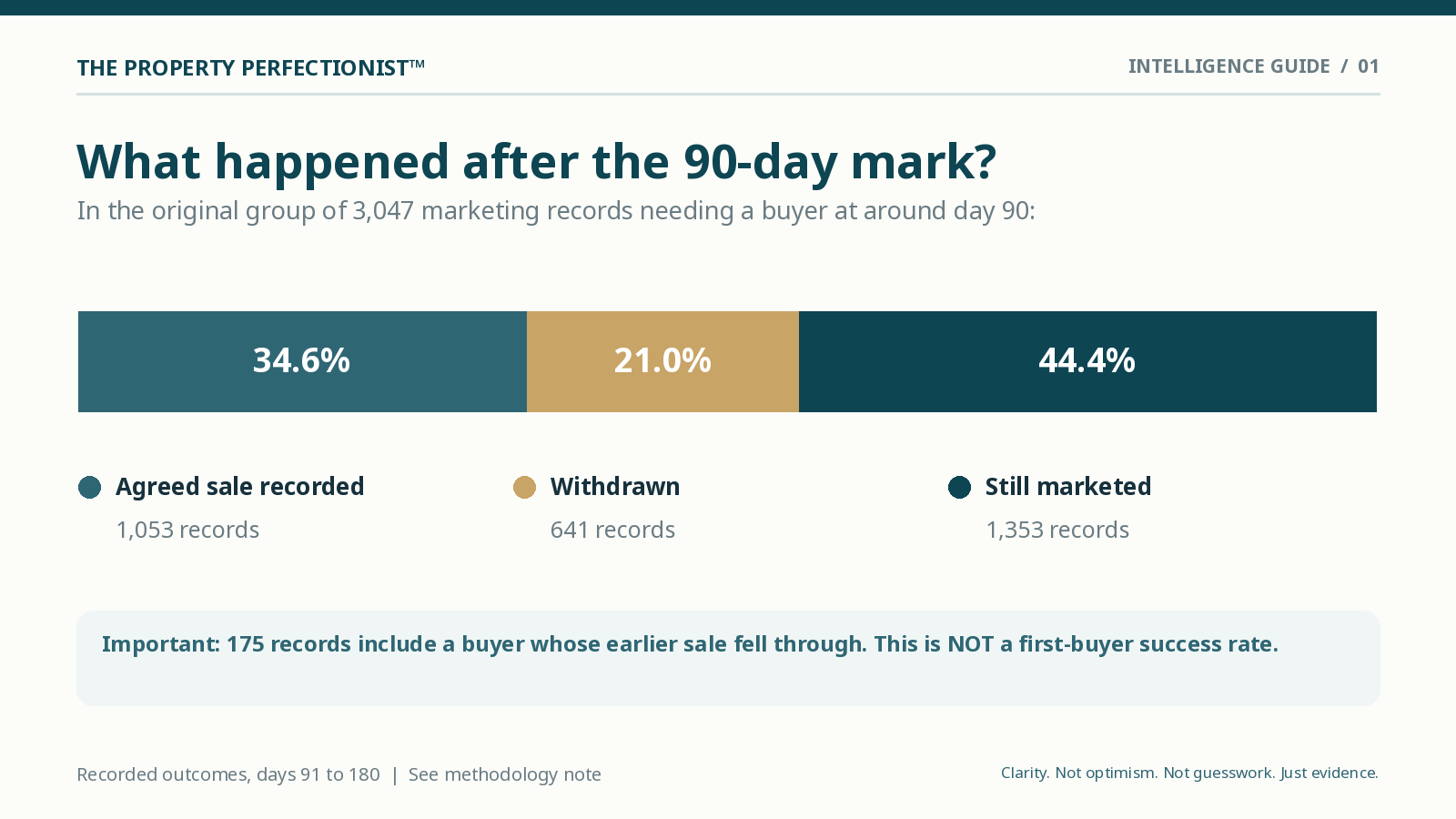
In the initial group of 3,047 marketing records identified as needing a buyer at day 90, roughly 35 in every 100 recorded an agreed sale during the following 90 days. About 21 were withdrawn and 44 were still being marketed without a buyer at the six-month mark.
That is an eye-opening result, but it’s not a verdict on any individual home. A later check found that 175 of those records had previously secured a buyer whose sale fell through. The chart therefore includes both first-time attempts and homes trying to find another buyer. So please don’t read it as the chance of finding a first buyer after 90 days.
What it tells me is that time alone rarely provides a strategy. At three months, there is a much more useful question: what, specifically, would give buyers a reason to choose this home now?
And no, not all types of property behave the same way
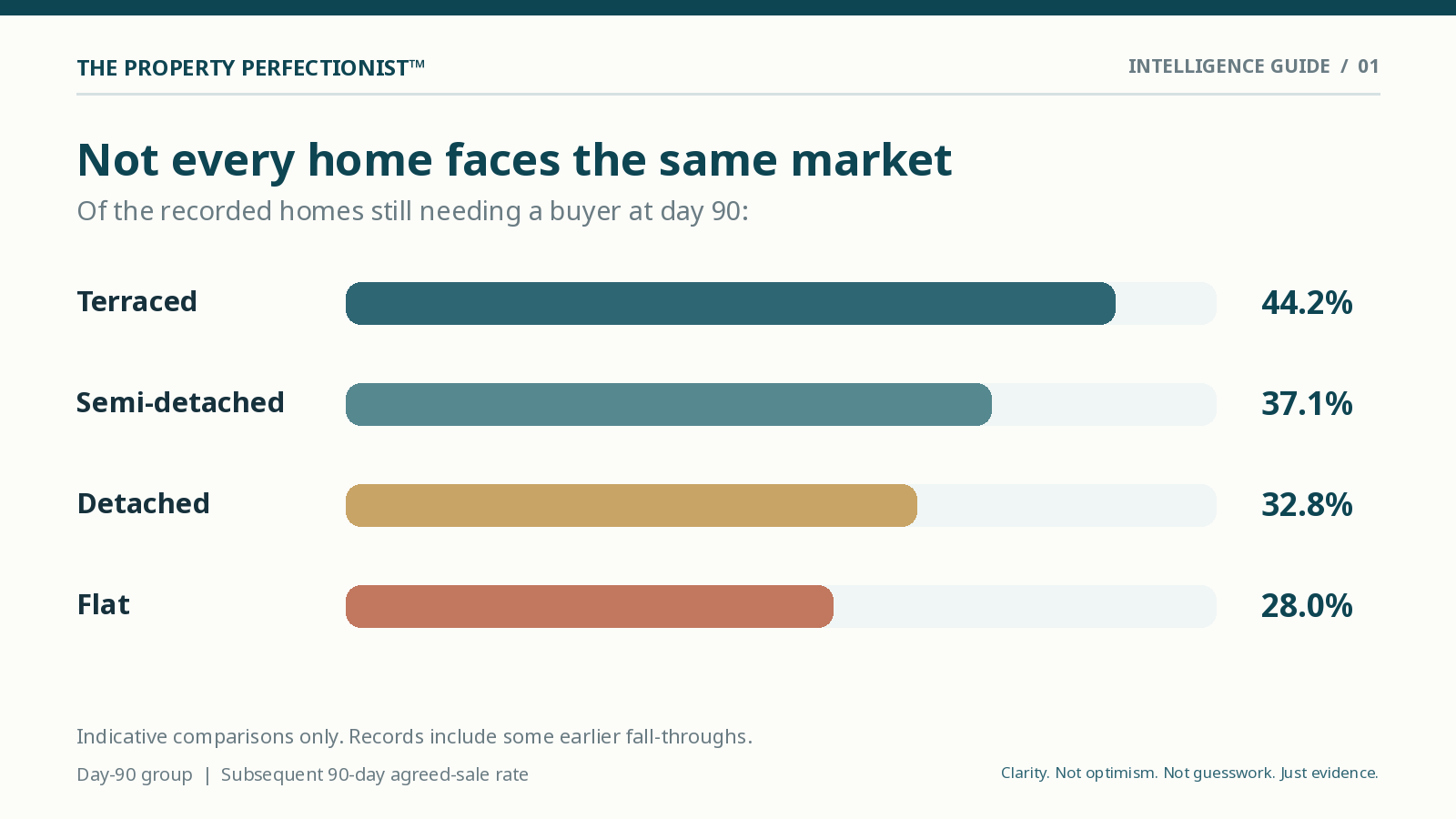
Among the recorded day-90 group, a higher share of terraced homes recorded an agreed sale over the following three months than flats: approximately 44% compared with 28%. Semi-detached and detached houses sat between those figures. These groups also differ in price and location, so I treat this as a broad pattern rather than the odds for any one type of home.
That doesn’t mean a flat is a bad investment or a terraced house will automatically sell. It means the type of home you’re selling, your asking price and the buyers you’re competing for all matter. Your own competition is more useful than a single Bromley-wide average.
Then two houses in Petts Wood made me stop
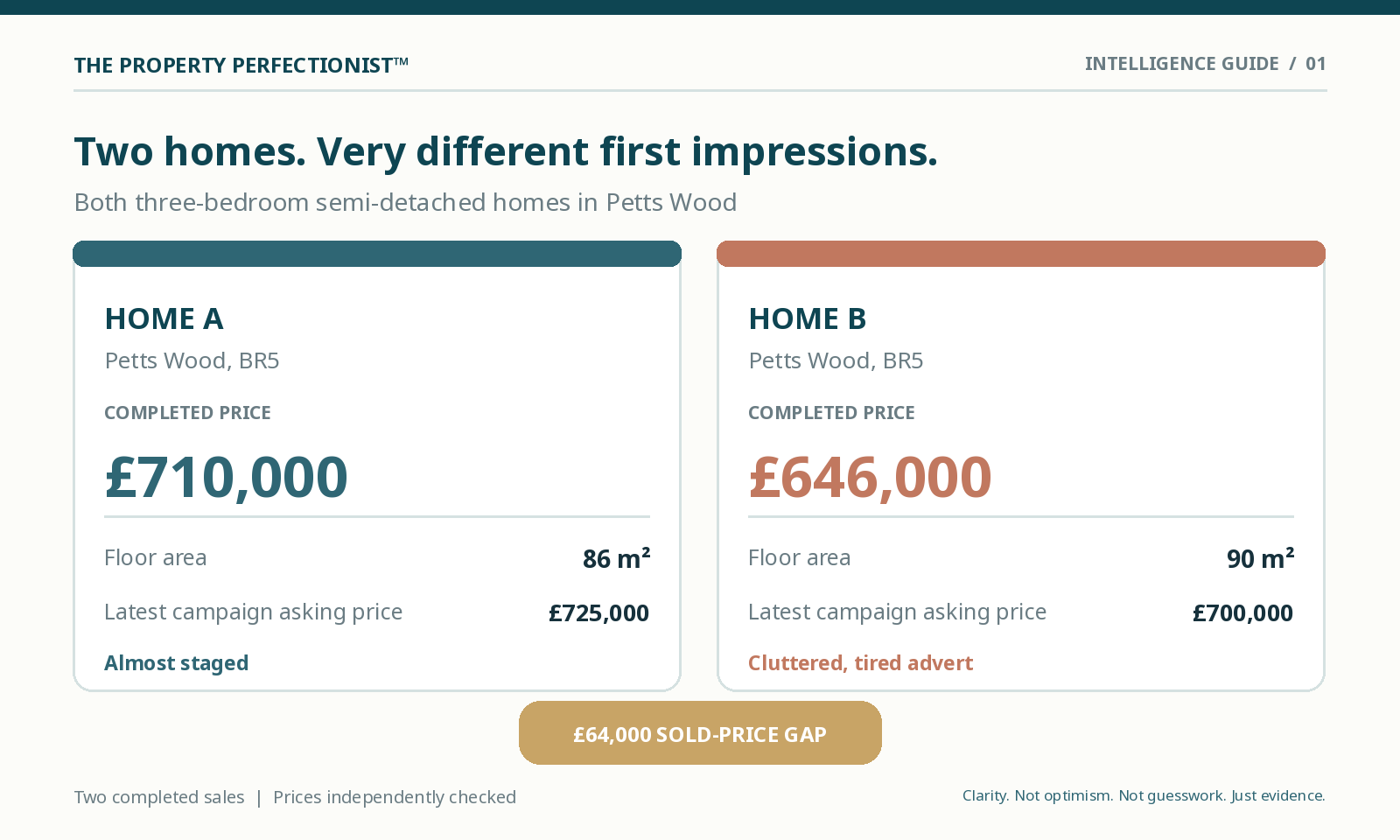
I compared two homes in Petts Wood, BR5, which sold within a year of each other. I’ll call them Home A and Home B. Both were three-bedroom semi-detached homes. One measured approximately 86 square metres, the other 90. The asking prices recorded when their latest marketing campaigns began were £725,000 and £700,000 respectively.
But the marketing told two completely different stories.
Home A was beautifully presented. The rooms felt considered, fresh and almost staged. The photographs made it easy to imagine moving in and getting on with life.
Home B’s marketing photographs showed a cluttered, tired-looking home. It was the sort of presentation that makes buyers start mentally adding up decorating, replacing things and the effort involved. That doesn’t mean it was a bad house. Far from it. But buyers make comparisons quickly.
The smaller, better-presented Home A completed at £710,000. The larger Home B completed at £646,000. That’s a £64,000 difference in the recorded sale prices.
Now, I’m not suggesting you can scatter a few cushions around and magically add £64,000. If only it were that easy! Their exact locations, layouts, gardens and condition also matter, and we can’t prove presentation caused the gap. But the comparison shows why I examine how a home looks and feels against its rivals, not just its square footage.
For completeness, the marketing records show a buyer after 15 days for Home A and a latest recorded buyer after 414 days for Home B. Because earlier offers can be overwritten in this dataset, please don’t take that second number to mean the property had no buyer at any point during all 414 days.
What buyers see, and what they may be thinking
A buyer doesn’t arrive with a spreadsheet and a calculator for every room. Often, it’s much more instinctive than that. They’re looking at photographs, comparing kitchens and gardens, thinking about the work involved and asking themselves which home feels worth the money.
A room full of furniture can look smaller than it is. Tired decoration can turn into an imagined refurbishment bill. A well-prepared room, on the other hand, helps someone picture their own furniture and their own life in the space.
These are examples of buyer thought processes, not survey results. They’re precisely the sorts of reactions I look for when reviewing marketing.

So is dropping the price the answer?
Sometimes. Price matters because buyers always compare what else their budget can buy.
But I would be wary of treating a reduction as the entire plan. The records show plenty of homes securing buyers after a change in asking price, but they do not retain enough earlier price-change history to prove that reducing was the reason. I deliberately left out one tempting reduced-versus-unreduced statistic because the underlying comparison was unreliable.
If you’re being advised to reduce, I’d want to understand what you’re competing against today, how your home presents in comparison, what feedback viewers have given and how the marketing will change alongside the price.
A new price on the same tired advert may be exactly what is needed. Or it may be just one part of a bigger answer.
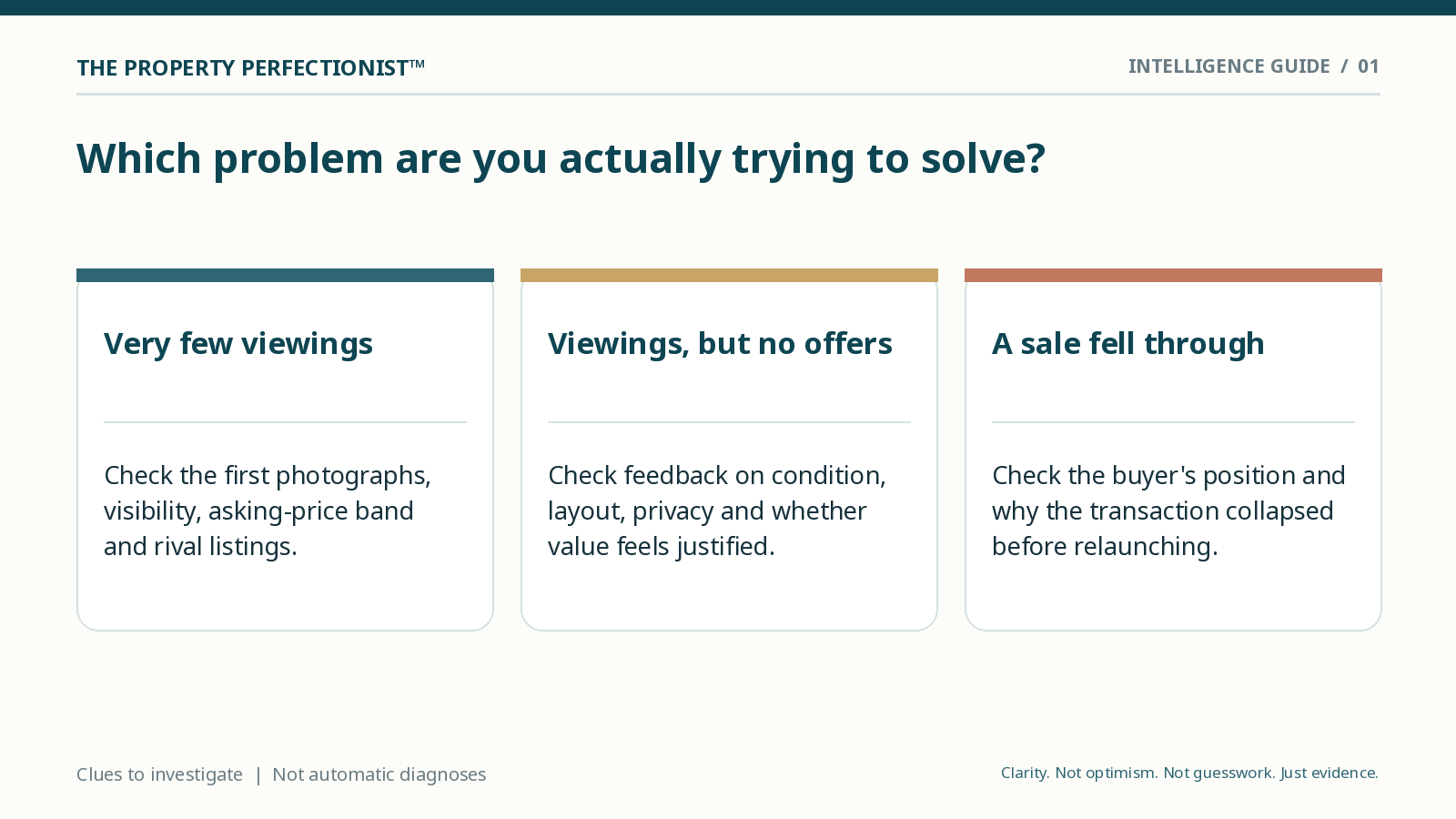
Are you getting no viewings, or viewings but no offers?
Those are two quite different clues.
Very few viewings makes me look first at online visibility, the first three photographs, the asking-price bracket and the alternatives appearing beside your listing. Plenty of viewings but no offers makes me look harder at what people discover in person: condition, layout, noise, privacy, the amount of work required and whether the price feels justified.
And if you had a buyer who pulled out, I’d want to establish why before treating the whole marketing campaign as a failure.
These aren’t diagnoses you can make from a chart. They’re questions that point the investigation in the right direction.
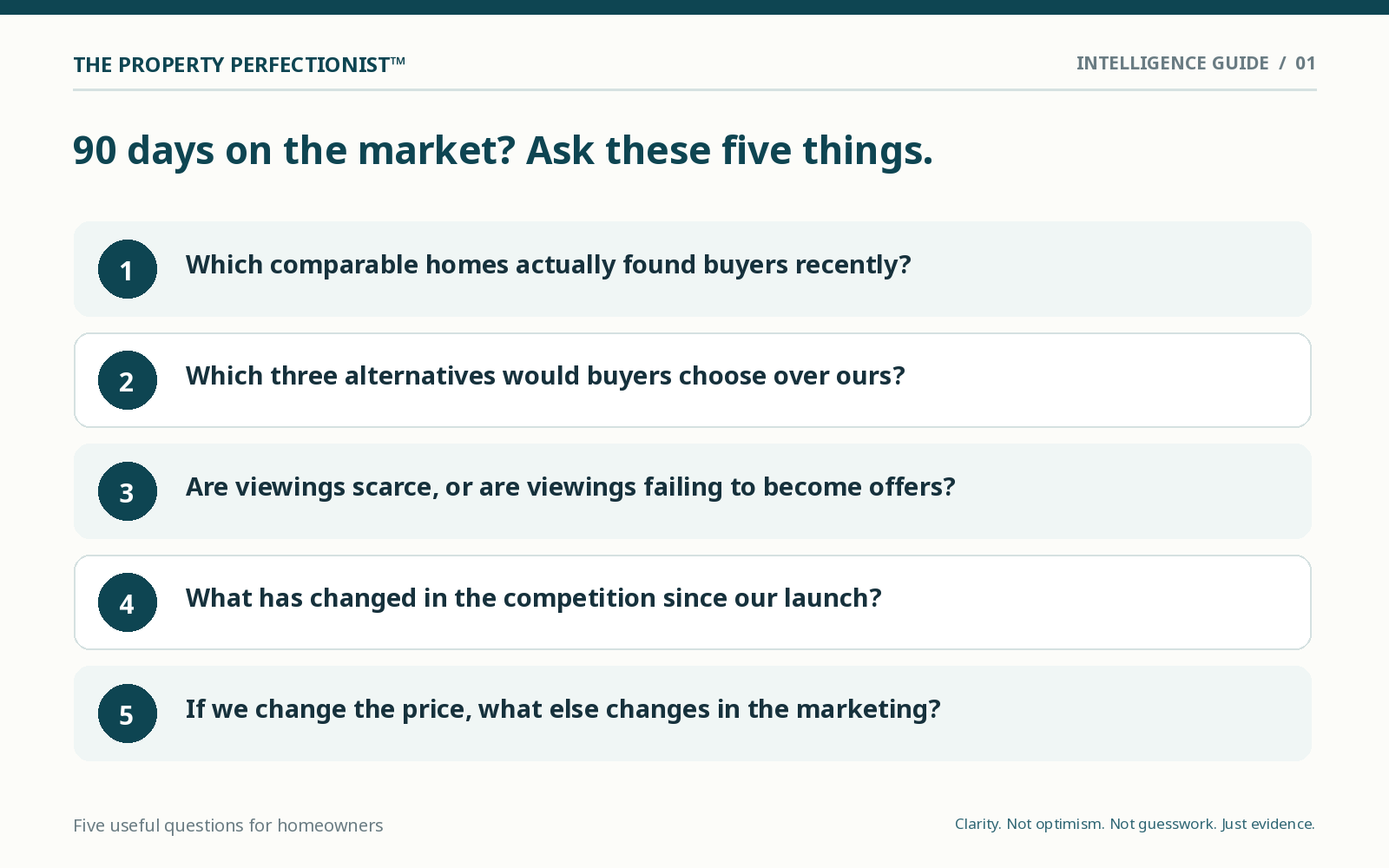
Five questions I’d ask my agent after 90 days
Here are the questions I’d ask. A good agent should be able to discuss them openly, even if some answers require more investigation.
- Which genuinely similar homes have found buyers in the last 30 days, and how did ours compare?
- If you were a buyer with our budget, which three competing homes would you shortlist ahead of ours, and why?
- Are we getting too few viewings, or are people viewing and deciding against us? What evidence do we have?
- What has changed in our local competition since we launched, including new listings and price reductions?
- If we change the asking price, what else will change in the photographs, story, distribution or launch strategy?
My final thought
The point of this investigation isn’t that every home needs a price reduction. It isn’t that every unsold home needs a new agent either.
It’s that a property deserves an evidence-based explanation of what’s happening before its owner is asked to make another important decision.
The first few weeks on the market are what I call the Momentum Window™. They matter because that’s when a home is new to buyers. Once that window has passed, I want to know what would make people look again. That might involve price, presentation, photography, film, the way the property is described or the people we’re reaching.
You can read how I turned this around at Wickham Way in my case study: Three Months on the Market, Then Stronger Offers from Stronger Buyers.
Every unsold property leaves clues. Sometimes the answer is straightforward. Sometimes it takes a bit of detective work. Personally, that’s the part I enjoy.
Related reading: Bromley house prices are holding up. So why are so many homes not selling?
Would you like me to investigate your home?
If your property is currently on the market and things have gone quiet, I’d be delighted to prepare a free Property Intelligence Report showing what buyers can choose instead and which questions your current marketing raises.
No pressure, and no need for a grand sales pitch. We could simply have a coffee and look at the evidence together.
James Hall | The Property Perfectionist™ | Powered by eXp | 07855 828 736 | james.hall@expuk.com
Clarity. Not optimism. Not guesswork. Just evidence.
Want a fresh pair of eyes on your home? Request your free Property Intelligence Report, call 07855 828 736 or email james.hall@expuk.com.
A note about the numbers
This analysis uses 8,013 residential marketing records with recorded campaign starts from 1 January 2025 to 23 May 2026, tracked to 19 November 2026. It covers BR1 to BR8 postcode districts, including areas outside the London Borough of Bromley. Listing dates can represent a recent campaign rather than a property’s original launch. Earlier agreed sales, reductions and relaunches may be missing because the records retain only the latest event dates.
The initial day-90 group of 3,047 includes 175 properties whose earlier agreed sales fell through. The corrected number with no identified previous buyer by day 90 is 2,872, but the three day-180 outcomes have not been recalculated for that narrower group. All outcome graphics therefore describe the original broader group, not the chance of attracting a first buyer. Agreed sales and completed sales are distinct; some completion records may arrive later. This is an interpretation of market records and not a valuation or a guarantee of any individual property’s outcome.


Leave a Reply