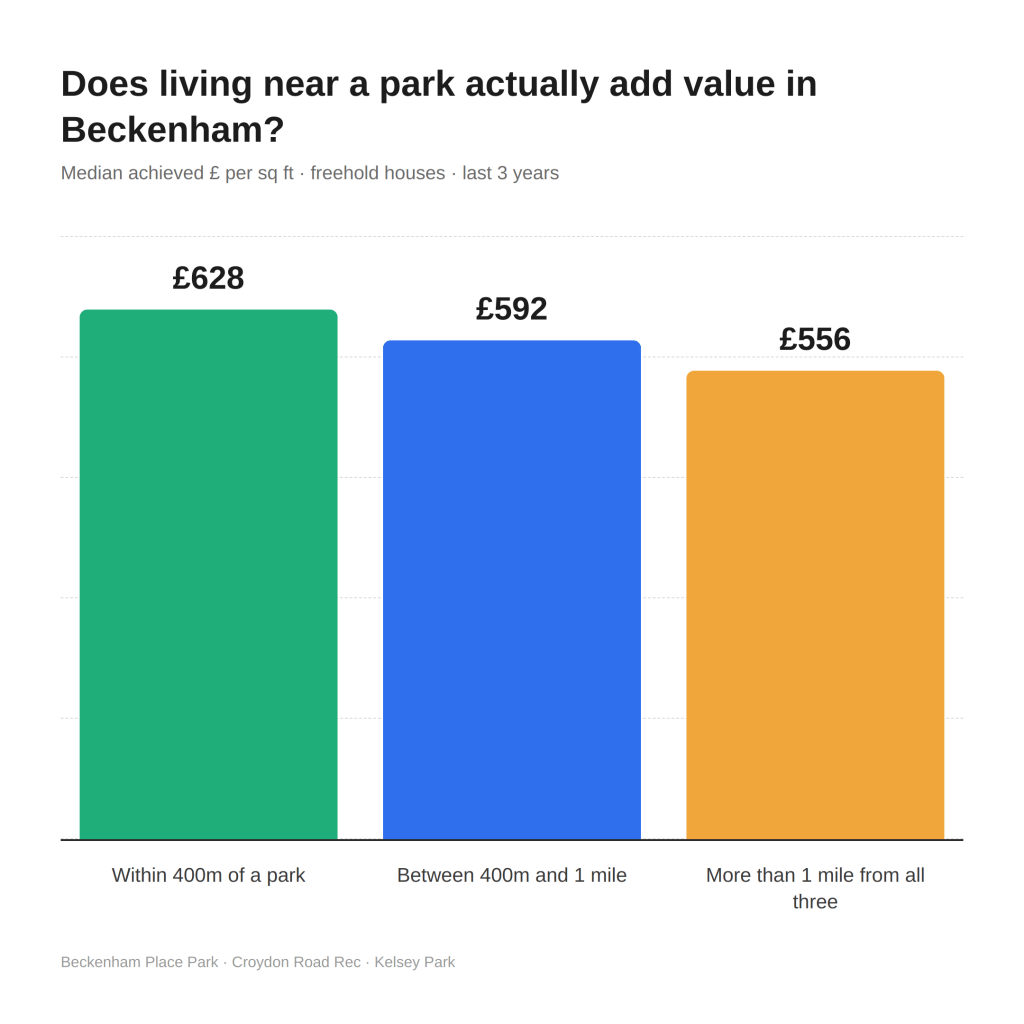
It’s one of those things everyone assumes is true. A house near a park just feels more desirable. But “feels more desirable” and “is actually worth more money” aren’t always the same thing, so I decided to check.
I looked at every freehold house sale across BR3 over the last three years, and measured each one’s distance from Beckenham’s three main green spaces: Beckenham Place Park, Croydon Road Recreation Ground, and Kelsey Park. Then I compared what buyers actually paid, per square foot, depending on how close they were.
What the evidence shows
| Distance from a park | Median achieved £/sq ft | Sample size |
|---|---|---|
| Within 400m of a park | £628 | 178 sales |
| Between 400m and 1 mile | £592 | 769 sales |
| More than 1 mile from all three | £556 | 162 sales |
The gap between the nearest and furthest groups works out to roughly 13%, and it isn’t a fluke of a small sample. This is drawn from hundreds of genuine completed sales, with a clean, consistent gradient the whole way through: closer to a park, higher the achieved price, every step of the way.
Why this probably isn’t a coincidence
It’s worth being honest about what this evidence can and can’t prove. This is a correlation, not a controlled experiment, homes near parks tend to sit on slightly older, more established roads too, and that plays a part. But the size of the gap, and how consistently it holds across nearly 1,100 sales, makes it hard to put down to chance alone.
Beckenham’s parks aren’t interchangeable amenities either, they carry real history that adds to their pull. Beckenham Place Park began life in the 1760s as the private grounds of a grand mansion built for John Cator, a wealthy timber merchant, and later served as a boys’ school and a sanatorium before becoming the open green space it is today. Croydon Road Recreation Ground has its own claim to fame: its Edwardian bandstand, the only surviving one of its kind left in the UK, is where a young David Bowie performed at the UK’s first free festival in 1969, and it’s now been officially named in his honour.
None of that shows up in a spreadsheet. But it’s plausibly part of why buyers are willing to pay a premium to live near these particular green spaces, not just any patch of grass.
What this means if you’re selling near one of Beckenham’s parks
If your home sits within that 400m radius, this is genuine, evidence-backed material worth using in how your property is marketed, not just an assumption to gesture at. A home’s proximity to a well-loved local park is a real, quantifiable part of its value, and buyers researching the area are increasingly likely to be checking exactly this kind of thing themselves.
If you’re just outside that radius, it’s still worth knowing where your home sits on this curve. The drop-off between “within 400m” and “further out” isn’t a cliff edge, it’s a gradient, and knowing exactly where your street falls on it is useful context for pricing a launch correctly.
The Property Perfectionist™ View
Buyer behaviour rarely comes from nowhere. People pay more to live near Beckenham’s parks because those parks have spent 150 years or more becoming exactly the kind of place worth living near. The evidence just confirms what history already set in motion.
If you’re thinking of selling near Beckenham Place Park, Croydon Road Rec, or Kelsey Park, and want to understand exactly what that proximity is worth for your specific home, I’d be glad to talk it through.
James Hall
The Property Perfectionist™
📞 07855 828 736 | ✉️ j.hall@moveli.co.uk
Clarity. Not optimism. Not guesswork. Just evidence.


Leave a comment