The Story of Beckenham’s Growth: How a Village of 955 People Became Home to More Than 82,000 People
When people ask me why Beckenham is such a sought-after place to buy a home, they often expect me to talk about schools, transport links or beautiful houses.
Those things certainly matter.
But the real answer lies in history.
To understand today’s property market, you first need to understand how Beckenham became Beckenham.
A tiny Kent village
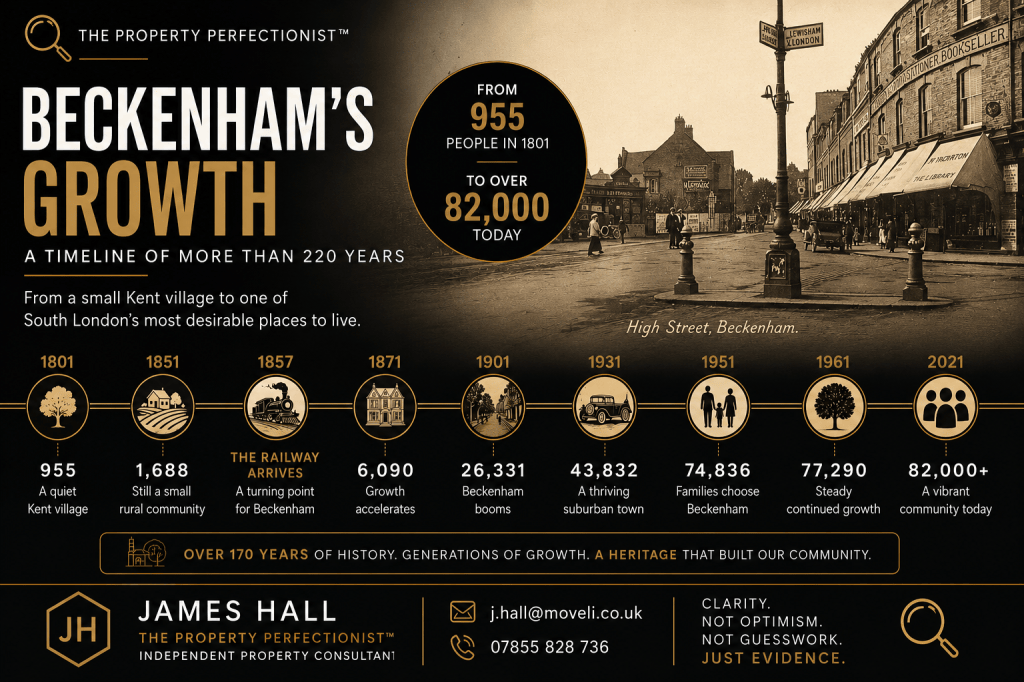
The first national census, taken in 1801, recorded Beckenham’s population at just 955 people.
It was a quiet rural village surrounded by farmland, woodland and large country estates. Life revolved around agriculture, with London feeling a world away despite being only a few miles north.
Population growth
- 1801: 955
- 1811: 1,093
- 1821: 1,180
- 1831: 1,288
- 1841: 1,608
- 1851: 1,688
For fifty years, growth was slow. Beckenham remained largely unchanged.
Then everything changed…
On 1 January 1857, the Mid-Kent Railway arrived at what is now Beckenham Junction.
It wasn’t simply a new railway station.
It was the beginning of modern Beckenham.
For the first time, wealthy London merchants, bankers and professionals could enjoy country living while commuting into the City.
Developers immediately recognised the opportunity.
Landowners, particularly the Cator Estate, began releasing land for elegant Victorian housing rather than dense urban development.
Wide avenues.
Detached villas.
Generous gardens.
Tree-lined streets.
The Beckenham we know today was beginning to take shape.
The population explosion
The numbers tell an incredible story.
- 1861: 2,124
- 1871: 6,090
- 1881: 13,045
- 1891: 20,707
- 1901: 26,331
In just 40 years, the population increased by more than 1,100%.
Few places around London experienced such dramatic growth during the Victorian era.
Beckenham keeps growing
The railway had transformed Beckenham from a village into a thriving commuter town, but the story didn’t end there.
As London expanded throughout the twentieth century, Beckenham continued to attract families looking for larger homes, better schools and more green space.
Population growth continued steadily:
- 1911: 31,692
- 1921: 33,345
- 1931: 43,832
- 1939 Register: 63,088
- 1951: 74,836
- 1961: 77,290
- 2021: Approximately 82,000
Today, the wider Beckenham area is home to around 82,000 people—an extraordinary increase from the 955 residents recorded in 1801.
That’s a population increase of more than 8,400%, or around 86 times larger than it was just over two centuries ago.
Why does this matter today?
Because history leaves clues.
The roads that buyers aspire to live on today weren’t built by accident.
The Avenue.
Foxgrove Road.
Park Langley.
Many of Beckenham’s finest roads were carefully planned for affluent London commuters seeking space, prestige and a healthier lifestyle.
Those same qualities still influence buyer behaviour today.
People don’t simply buy a house in Beckenham.
They buy excellent rail connections into London.
They buy highly regarded schools.
They buy mature parks and green spaces.
They buy generous Victorian plots.
They buy independent cafés and a genuine village atmosphere.
Most importantly…
They’re buying more than 170 years of carefully planned growth.
That’s why two houses of similar size can achieve very different prices.
One sits on an ordinary road.
The other sits on a road whose desirability has been growing since the railway first arrived in 1857.
The Property Perfectionist™ View
Most people think valuing property is simply about looking backwards at comparable sales.
I don’t.
Comparable evidence is important, but it’s only one piece of the puzzle.
The best property consultants understand why buyers are prepared to pay a premium.
Sometimes, the biggest clue isn’t in last month’s Land Registry data.
Sometimes it’s hidden in decisions made more than 170 years ago.
Because every road has a history.
Every neighbourhood has a story.
And every property leaves clues.
James Hall
The Property Perfectionist™
Clarity. Not optimism. Not guesswork. Just evidence.


Leave a comment